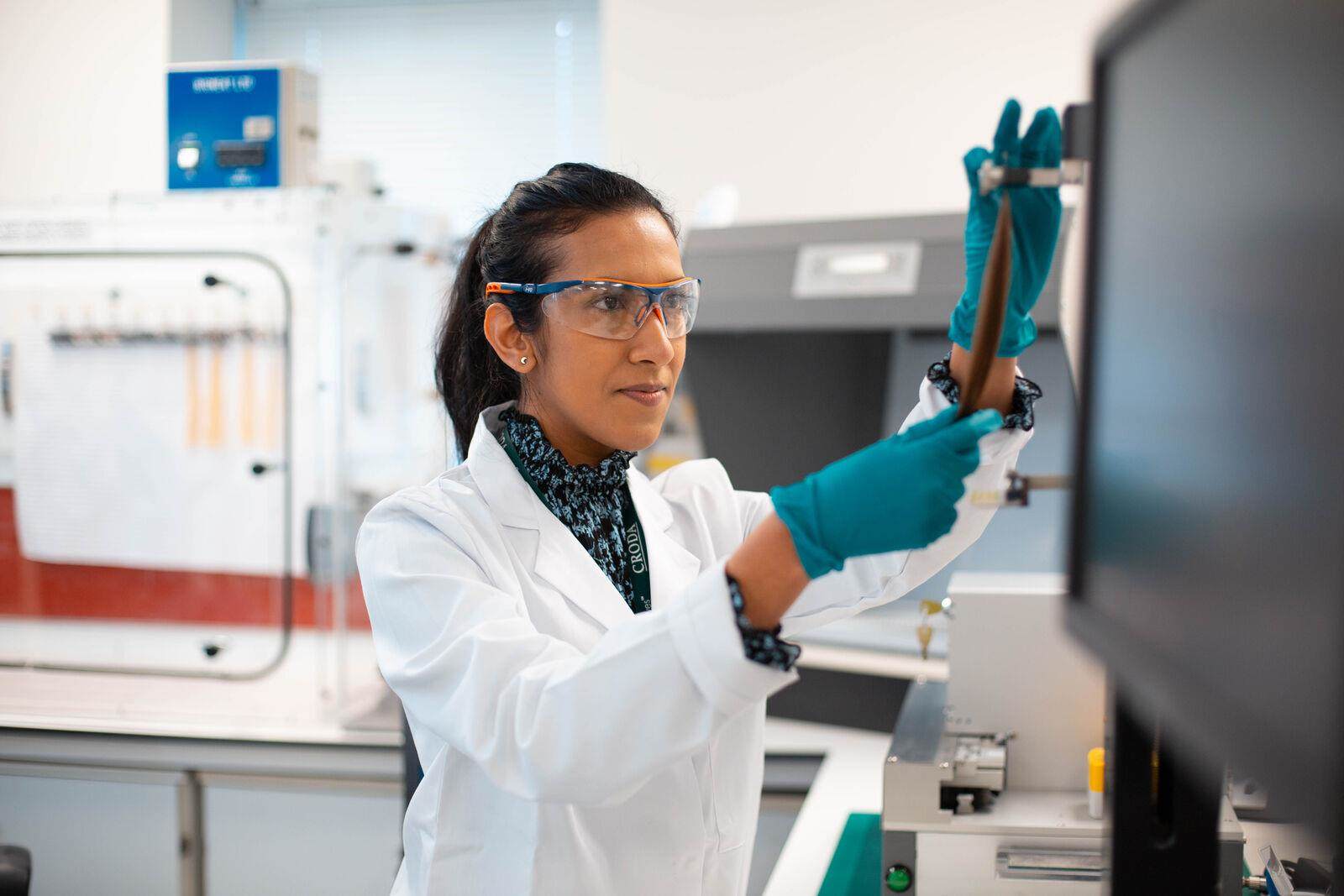
Meet the Expert: Dhanila Varkey, Applications Team Lead, specialising in topical and transdermal delivery, with a strong focus on nanotechnology enabled solutions.

What does your role as Applications Team Lead at Croda Pharma in India involve?
I work from Croda’s Global Technical Centre in Hyderabad, India, providing tailored technical solutions to customers across South Asia and troubleshooting formulation challenges to help achieve product success using our wide excipient portfolio.
My particular areas of expertise include designing topical and transdermal formulations, spanning conventional lifecycle management strategies as well as advanced drug delivery systems enabled by nanotechnology.
What do these formulations look like on shelf?
Topical and transdermal formulations differ in format and purpose. Topical products deliver actives to the skin’s surface or targeted layers and are commonly seen as creams, gels, ointments, or lotions in tubes, jars, or pumps for stability and controlled application. These dominate OTC shelves in categories like pain relief (e.g., muscle pain gels) and dermatology (e.g., anti-itch creams). Transdermal systems, designed for systemic delivery, use diffusion or reservoir mechanisms and appear mainly as adhesive patches in OTC segments such as smoking cessation and pain management.
Are there any issues particular to topical and transdermal formulations that Croda’s ingredients help solve?
Customers often face challenges such as poor solubility and bioavailability of active ingredients, skin permeation, stability issues, or undesirable texture or sensory properties. Our pharma Ingredients portfolio can play a critical role in overcoming these hurdles.
Beyond functionality, our excipients could enable the creation of differentiated products with strong claims, such as improved absorption, a long-lasting effect, or a natural positioning, giving brands a competitive edge.
Are you seeing any novel innovations or formulations emerging this space?
The dermaceutical space is evolving rapidly with innovations such as advanced delivery systems like microneedle patches and smart nanocarriers for targeted, controlled release of actives.
Biotech-derived ingredients, including vegan collagen, peptides, and exosomes, are gaining traction for regenerative and anti-aging benefits.
We are also seeing formulations focusing on microbiome health and barrier repair using probiotics and ceramides, while hybrid products combine skincare and cosmetic functions for multifunctionality.
Nutricosmetics and ingestible beauty supplements are also on the rise, alongside personalised solutions powered by AI diagnostics and smart devices.
You are a specialist in nanotechnology. How is this being used to benefit drug formulations?
Normally, when you take a drug, a lot of it doesn’t go exactly where it’s needed. Nanotechnology uses super tiny particles like GPS-guided couriers to deliver the medicine directly to the target.
These couriers protect the medicine, make it easier to absorb, and release it slowly so it works better and lasts longer. This means treatments can be more effective, safer, and even reduce side effects.
Nanotechnology is about solving problems that traditional approaches simply can’t. It’s about creating solutions that have the potential to become breakthrough therapies.
Knowing that it can lead to better treatments for skin conditions, chronic diseases, and even life-saving therapies motivates me every day.
Are there any innovative uses that are currently shaping the work you do?
Nanotechnology is playing a big role in solving challenges that traditional formulations struggle with.
For instance, many drugs have poor water solubility, which limits their effectiveness. By using nanocarriers we can significantly improve solubility and ensure the drug remains stable over time.
Another major advantage is better permeation. Nanocarriers can cross biological barriers, such as the skin, more efficiently, delivering actives exactly where they’re needed.
They also allow controlled and sustained release, which improves patient comfort and reduces dosing frequency.
These innovations are not just solving problems, they’re opening doors for effective therapies and smarter drug delivery systems.
Is there an example you can share?
I’m currently exploring Nanotechnology-based systems such as liposomes, and nano/microemulsion gels which significantly improve the penetration and deposition of actives across the skin barrier. Liposomal carriers encapsulate sensitive actives, protecting them while facilitating targeted release into specific skin layers.
Nano- and microemulsion gels further enhance solubilisation, stability, and permeation, enabling superior efficacy even for poorly soluble or challenging actives in topical formulations.
What does the future hold for the ingredients and application areas you work on?
The excipient industry is entering an exciting phase driven by innovation and evolving market needs.
Life cycle management will become critical as companies look for excipients that not only maintain product stability but also enable newer dosage formats (e.g. moving from a cream to a foam).
Complex formulations and advanced drug delivery systems, are pushing demand for multifunctional specialised excipients that can optimise dermal penetration, enhance drug solubility, and support controlled or sustained release profiles across the skin barrier.
The future will see excipients not just as inactive ingredients, but as enablers of innovative therapies and faster development timelines.
In what way do you think Croda can fuel this innovation and growth?
As a leader in high purity excipients and pharmaceutical materials, we support the advancement of next generation drug delivery systems.
Our broad portfolio for human and animal health, combined with strong formulation and regulatory capabilities, enables us to meet the most demanding formulation challenges.
Customers worldwide trust Croda for unmatched product quality, reliability, and comprehensive regulatory support.
This reputation for excellence minimises development risk and empowers innovation, enabling faster regulatory pathways, smoother manufacturing scaleup, and greater freedom to explore new formulation possibilities.

Hear more from Dhanila on her work around nanotechnology
Meet our experts

Will Small, Research & Technology Specialist

Christian Wells, Applications Team Lead