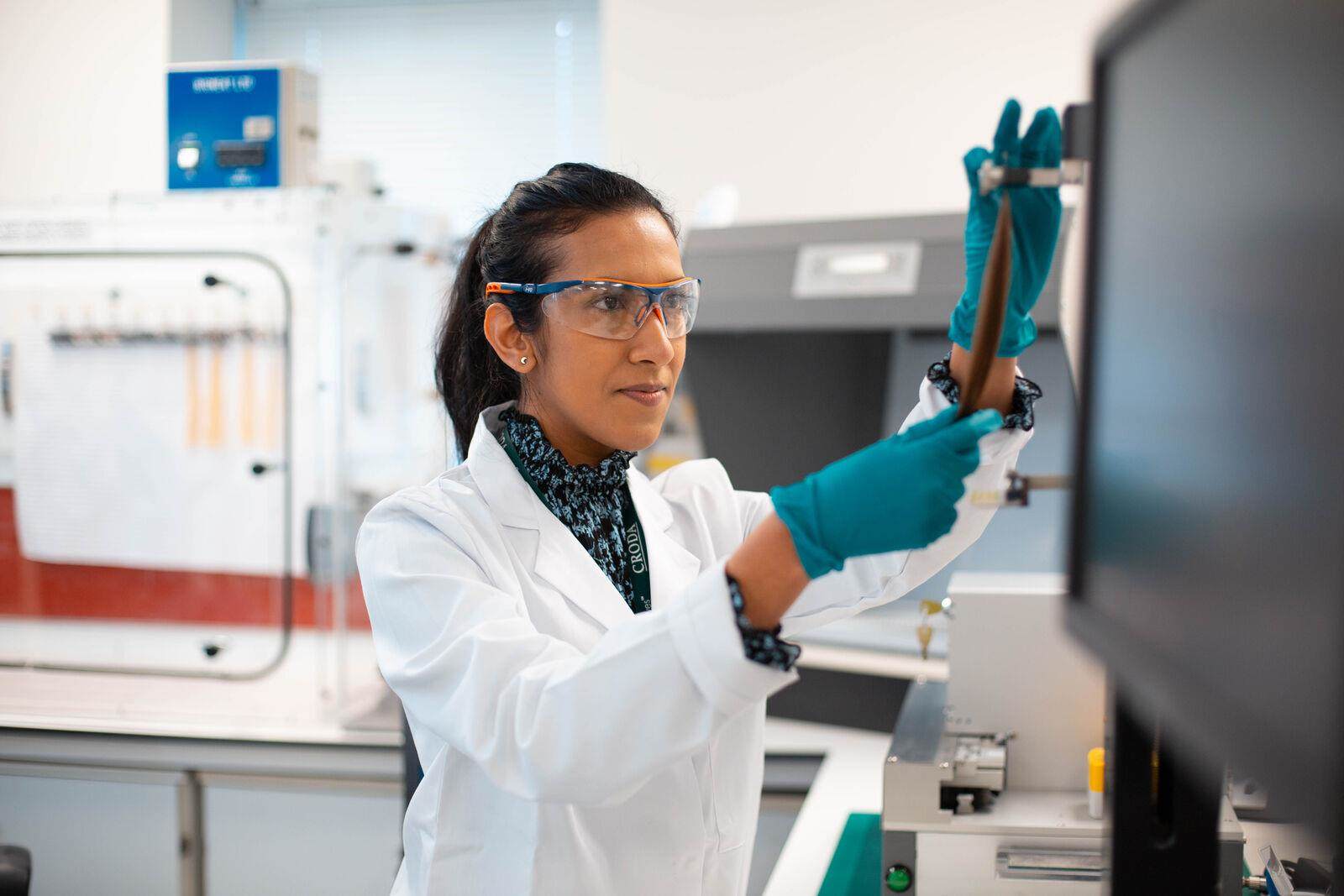
The science of biotech beauty: Farahdia Edouard on developing innovative ingredients

What does your role as Senior Research & Technology Manager at Croda Beauty North American HQ involve?
I have broad responsibility for the innovation activities in Beauty Care at Croda. I oversee the technical teams responsible for applications and claim substantiation for new and existing product developments for hair, skin, sun and colour cosmetics in the US. I also have a dual role supporting the global hair care strategic programme in coordination with the global hair care team.
Can you tell us about some of the hair care innovations that you and your team have worked on?
In my 20 years with Croda, I’ve worked with brilliant teams of scientists who have helped launch products to market that are successful to this day.
In the hair care space, Croda has always been a leader in the development of speciality quats (quaternary ammonium compounds). These technologies provide conditioning benefits to the hair. We’ve been able to further derivatise these products to impart other functional benefits beyond conditioning properties, for instance adding a UV absorber to protect hair from the damaging effects of UV rays.
As demand grows for more natural and sustainable alternatives to commonly used hair care ingredients we’ve developed innovative solutions such as SensaLuxe™ DF, a silicone-free emollient ester delivering performance and sensory benefits comparable to traditional silicone-based ingredients.
In addition, we launched KeraMatch™ V in response to the growing market for vegan alternatives for keratin. Fast forward to today, and we are the first supplier to market with a biotech-derived keratin, KeraBio™ K31.
As project lead, how did you and your team take KeraBio™ K31 from idea to launch in just 12 months?
A lot of things made this project the success it is today.
1. We established a very clear project brief and core team that met regularly from the onset
One of the goals of our innovation roadmap and global strategic plan for hair care was to be the first ingredient supplier to launch a bond-builder for long-lasting repair. The brand Olaplex disrupted the market over 10 years ago with this new bond building claim. K18 built on that with a biomimetic technology. We wanted to do it using something no other supplier had on the market - a recombinant, biotech keratin.
We developed a project brief with very specific technical and market success criteria, technical storytelling, and consumer benefits. We set up a core and extended team that met every week and went to work.
This was a Sprint project, with a 12-month deadline. We investigated various options, including potential partnership routes, then learned of progress Croda’s biotech team at Daresbury had made developing a keratin that could be a potential fit for our project. In collaboration with the US Product Validation and Claims Substantiation (PVCS) team, we started screening numerous candidate molecules and landed on KeraBio TM K31.
It’s the first hair care launch that fully utilises Croda’s biotech capabilities. And hopefully, it’s the first of many. .
2. We knew the hard consumer claims we wanted to go after
We wanted to leverage strength and make the claim of 100% stronger hair versus the leading benchmark on the market. We wanted to demonstrate repair from within and restoring your hair to its virgin-likestate prior to chemical damage. And we wanted to demonstrate evidence of bond building.
3. We had the testing capabilities in-house to substantiate majority of these claims, at speed.
Our PVCS Testing Lab is a centre of excellence for hair care testing. Our vast instrumental capabilities - from tensile strength testing to advanced imaging and spectroscopic analysis - allow us to understand the mechanism of action and evaluate our ingredients’ performance both on the surface and within the internal structure of the hair fibre, giving us insight inside and out.
In the PVCS lab, we can test for effects including (but not limited to the following):
- Hair manageability, i.e. conditioning, combability, softness, smoothness
- Repair and strength improvement, anti-breakage
- Colour enhancement and/or protection
- Styling performance, i.e. frizz, volume, curl enhancement
- Surface and structural imaging analysis
- High-resolution spectroscopy techniques
These techniques enable us to visualise and quantify structural changes in hair fibre before and after treatment, and observe how ingredients interact with and modify the hair structure.
We’re also adapting existing tools and developing new methodologies to measure performance across diverse hair types to ensure our innovations are validated for a broad consumer base.
To complement our testing capabilities, we also have an in-house salon with a full-time cosmetologist and product evaluator. Conducting controlled studies on people with a wide range of hair types ensures our ingredients are evaluated under realistic usage conditions, that we see product results on real hair and get feedback from real people.
Taking this integrated approach to test KeraBio K31 allowed us to deliver
- Stronger claims supported by both quantitative and consumer-perceivable data
- Gain a deeper understanding of ingredient functionality and mode of action, enabling better targeted product development
- Broader market relevance through inclusive testing
And this comprehensive validation gave us real confidence that we were market-ready at launch
What are the key benefits of being the first to market biotech keratin?
When we think about future ingredients and applications, the drivers, especially for hair care, are sustainability, less aqua toxicity, more biodegradability, inclusivity and having products that are tailored for different demographics and different hair types. We can access all of that using our biotech platform.
With KeraBio K31, it allowed us to design a product using biotech that we know will have a benefit on the hair, that’s vegan, sustainable, doesn’t have impurities, and works not at 0.5% active, but at 0.1% active. This opens the market in terms of affordability, access and reach.
Will KeraBio K13 become a best seller for Croda Beauty and hair care?
We monitor new products and measure how well they’re doing post-launch based on key metrics such as customer sampling activity, pipeline opportunities and orders.
We’re seeing very good traction on all these metrics. KeraBio M K31 is one of the top sampled products globally.
New product launches are also assigned a peak sales value, based on market potential. This is typically five years post-launch, but I believe we’ll surpass that peak sales value much sooner.
Our first sellable pilot batch sold out within weeks, and we recently learned of a commercial success story where a professional brand in Japan launched their salon product on the market, which sold out in two hours.
Where do you see this technology going next?
The beauty of the technology doesn't just lie in KeraBio K31. It's in the platform we can leverage to create a full range of biotech peptides designed for different hair types and damage levels.
We’re still learning and continue to test and generate new data for KeraBio K31. We’re gaining more insights into the molecule and how we can design the next KeraBio variants for different positioning and different claims that are more targeted and potentially more personalised.
The future looks bright thanks to a cohesive team that had the drive to do more and worked extra hard to deliver.

What is KeraBio™ K31?

The future of biotechnology in beauty: Frederic de-Baene on engineering biology

Plant cell culture in beauty: Cécile Jonchier on the science behind the technology